Analyst assessment
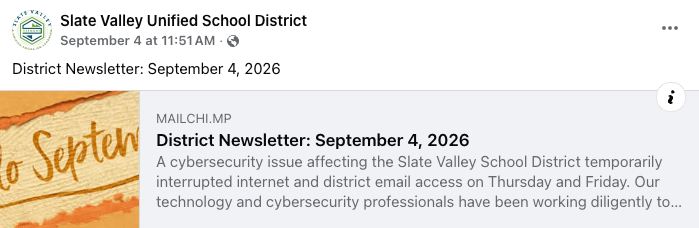
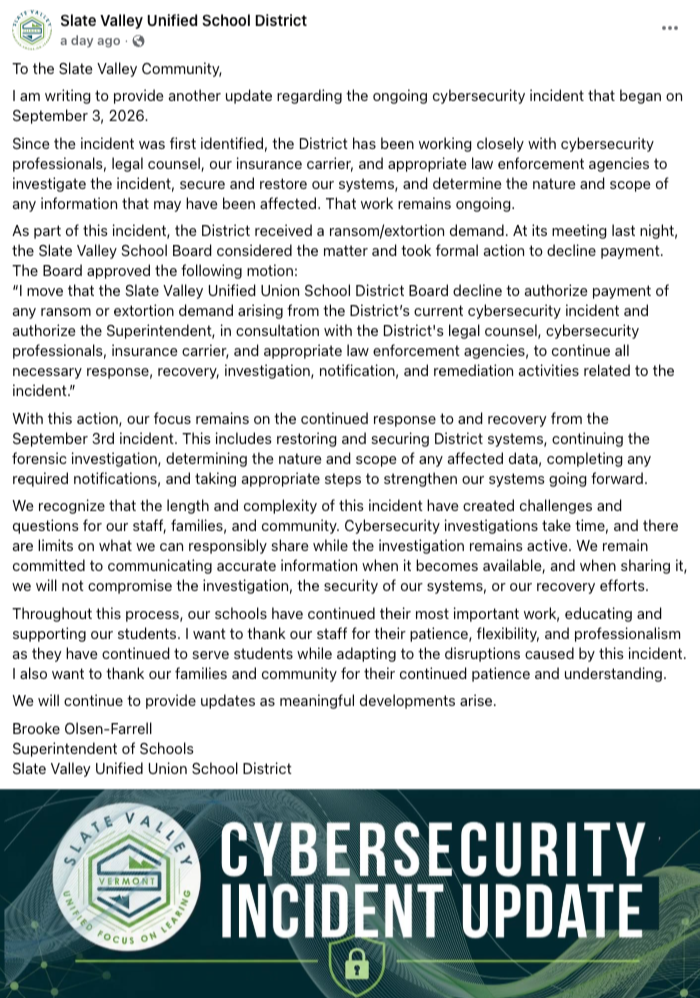
Slate Valley Unified Union School District experienced a cyberattack beginning Sept. 3, 2026, that disrupted district technology, internet and email. The district’s initial notice identified a cybersecurity issue. Its Sept. 29 update confirmed an extortion demand and said the school board had declined to authorize payment.
WCAX reported Oct. 2 that officials said attackers accessed business documents and employees’ personal information and threatened to release the data. Superintendent Brooke Olsen-Farrell told VTDigger that attackers obtained teachers’ records and that current and former teachers’ information was believed compromised. DysruptionHub assesses with high confidence that the incident involved data compromise and extortion; encryption remains unestablished.
Operational significance
Schools stayed open while staff used workarounds for unavailable technology and communications. Families were directed to telephone schools. District notices documented inconsistent email and delayed Chromebook access during restoration.
Slate Valley serves Benson, Castleton, Fair Haven, Hubbardton, Orwell and West Haven in western Vermont. Its central office in Fair Haven anchors the affected organization; the district’s service coverage does not imply an outage of municipal services throughout those towns.
Current status
Olsen-Farrell said internet and PowerSchool access returned after approximately a week, according to VTDigger’s Oct. 2 reporting. She described continuing disruption, investigation and work to identify affected people. WCAX reported that the district continued working with law enforcement and notifying individuals. These are partial recovery and response findings, not a complete all-systems restoration.
Disclosure posture
The district acknowledged the incident, disclosed the demand and explained its decision against payment. The FBI’s Albany office confirmed investigative assistance to VTDigger. WCAX reported that the district did not believe student data had leaked. In later reporting, the superintendent said current-student compromise could not be ruled out, although she considered it unlikely. DataBreaches.net’s Oct. 4 report described examining samples containing current-student information, including spring 2026 special education notes, alongside employee and dependent records. That reporting provides evidence of a broader data compromise than staff records alone; it does not authenticate the entire claimed dataset.
The district’s notice filed with New Hampshire describes possible unauthorized access to network information between Aug. 26 and Sept. 3, 2026. Counsel’s Oct. 18 letter said the district completed its data review Sept. 17, identified about eight potentially affected New Hampshire residents Oct. 9 and began mailing notices Oct. 14. Potentially affected information included names with Social Security numbers or financial account information. The New Hampshire count does not establish the total number affected. The district said it reset passwords, investigated and reviewed its data-protection procedures.
Confidence and uncertainty
Confidence is high in cyber causation, service disruption, obtained staff records and the extortion threat because district officials described those findings. The public record does not establish actual file encryption or a ransomware family.
A Kairos victim listing alleged possession of 647 GB of student and employee databases. We also received an Oct. 1 email claiming information about more than 1,500 employees and threatening release. The apparent spreadsheet image, linked ZIP file, claimed quantities and sender identity have not been authenticated. DataBreaches.net reported that Kairos claimed 762 GB in total, including 647 GB of SQL databases, and provided samples to the publication. The reporter examined records concerning students, employees and dependents and performed limited address checks. Those observations strengthen the evidence of data compromise but do not validate the total volume, every record, or Kairos’s responsibility for the intrusion. The predicted publication deadline does not establish that a full leak occurred.
Analytic gaps
The initial access route, precise activity within the potential Aug. 26–Sept. 3 access window, affected hosts, encryption scope, complete downloaded-data inventory and overall affected-person count, exact demand amount, actor identity and full recovery date remain unresolved.
Operational disruption is assessed as presumed resolved as of Nov. 2. Targeted official and public-source checks found no newer specific material restriction, alongside the documented recovery signals. A complete restoration date remains unconfirmed; ongoing investigation and data notifications are separate.