Analyst assessment
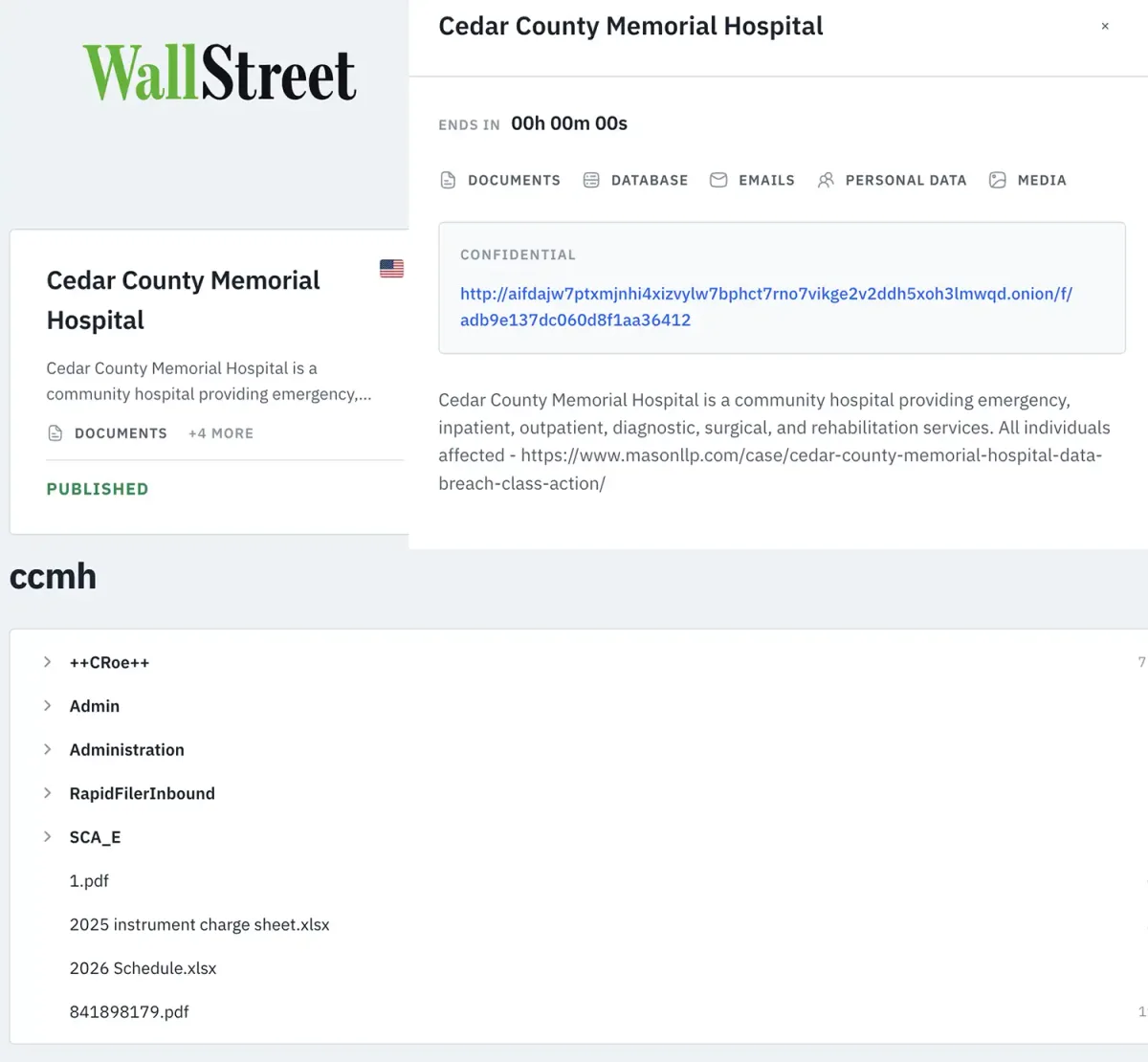
DysruptionHub assesses with high confidence that Cedar County Memorial Hospital experienced a confirmed cyber incident beginning Aug. 14, 2026. The hospital’s official incident update documented an information technology disruption that required a voluntary network shutdown and outside forensic investigation. A Sept. 10 report by OzarksFirst characterized the event as a cyber incident, and a Wallstreet leak-site listing provides a direct public cyber claim.
The evidence does not establish that ransomware encrypted hospital systems or that Wallstreet caused the incident. DysruptionHub assesses ransomware involvement and Wallstreet attribution with low confidence because CCMH has not confirmed either proposition and the public claim has not been independently corroborated.
Operational significance
CCMH said internet access, its patient portal and its Meditech electronic health record were unavailable at the hospital and Medical Mall Clinic. In an Aug. 17 Facebook notice, the hospital asked patients to bring paper physician orders and current medication lists and warned of longer waits while staff used downtime procedures.
Imaging systems could not transmit files to radiologists. The emergency department remained open but partially diverted trauma or critical patients who required immediate advanced imaging. In an official reply accompanying its Aug. 23 Facebook update, the hospital also said it temporarily was not accepting card payments and would resume only when it was safe.
Clinical care continued under backup procedures, but clinical records, electronic orders, patient access, payment processing and diagnostic-imaging workflows could not operate normally. In its Sept. 10 update, the hospital reported treating 170 emergency patients, admitting 12 patients, seeing 303 Medical Mall Clinic patients and 203 Specialty Clinic patients, completing 15 surgeries and performing 286 radiology scans during the downtime. These figures document care delivered under workarounds, not uninterrupted access to normal systems.
Current status
CCMH reported Aug. 28 that routine operations had returned, Meditech and the patient portal were restored, electronic orders resumed and ambulance diversion ended. Staff still had to enter manually kept records into the EHR, but the restoration statement supports treating the operational disruption as resolved Aug. 28. The continuing forensic investigation does not by itself indicate continuing service disruption.
Disclosure posture
The hospital has described the event as an IT disruption and has not confirmed ransomware, Wallstreet responsibility or patient-data compromise. External reporting and the Wallstreet listing provide the public cyber characterization; CCMH’s statements provide direct evidence of disruption and recovery.
Confidence and uncertainty
Confidence is high that the disruption occurred and materially affected hospital operations because CCMH documented the network shutdown, system outages, longer waits, manual workarounds, payment limitations, imaging limitation, partial diversion and restoration timeline. Cyber involvement is confirmed from credible external characterization and a stable threat-actor claim, but confidence is lower on technical cause because the hospital has not released a forensic finding.
Electronic clinical records were unavailable during the EHR outage. Whether patient information was accessed or stolen remains unresolved. The hospital’s Sept. 10 statement and a Sept. 17 HIPAA Journal report said patient-information involvement remained under investigation. The lawsuit and Wallstreet claim allege data theft, but those allegations do not establish unauthorized access, exfiltration, publication or the categories and number of records involved.
Analytic gaps
The public record does not establish the initial access vector, exploited vulnerability, compromised account or host, dwell time, malware family, encryption scope, ransom demand, payment status, data-exfiltration scope, affected data categories, number of affected people or whether any authentic hospital data was published. It also does not establish whether a third-party provider contributed to the intrusion.