Analyst assessment
DysruptionHub assesses with high confidence that Oklahoma Manufacturing Alliance experienced a contained ransomware incident on July 15, 2026. OMA told News 9 that ransomware activity targeted two employee computers and affected a limited portion of its local network. Its IT team identified and isolated the affected systems, then restored access through a separate secure network later that morning.
OMA’s direct ransomware characterization supports confirmed ransomware at the organizational-reporting level. The public record does not identify the ransomware family, encryption behavior, initial access vector, affected files, compromised credentials or specific security controls involved in containment.
Operational significance
The incident temporarily disrupted access to part of OMA’s local network, but the available reporting indicates a narrow internal impact rather than a prolonged or statewide service interruption. Access was restored the same morning, and no source reports closure of the organization, interruption of its manufacturer-support programs or downstream effects at client companies.
OMA is a statewide manufacturing-support organization rather than a production facility. Its official website describes a network of experts that provides assessments, training, engineering, supply-chain, workforce and technical services to manufacturers. The operational significance therefore lies in the temporary loss of internal business-network access, not disruption of industrial production or control systems.
Disclosure posture
News 9 published the first identified news report on Aug. 8, more than three weeks after the July 15 event. The report attributed the incident date, ransomware characterization, containment, restoration and data-impact statement directly to OMA. The reviewed sources do not show a separate contemporaneous public incident notice from the organization.
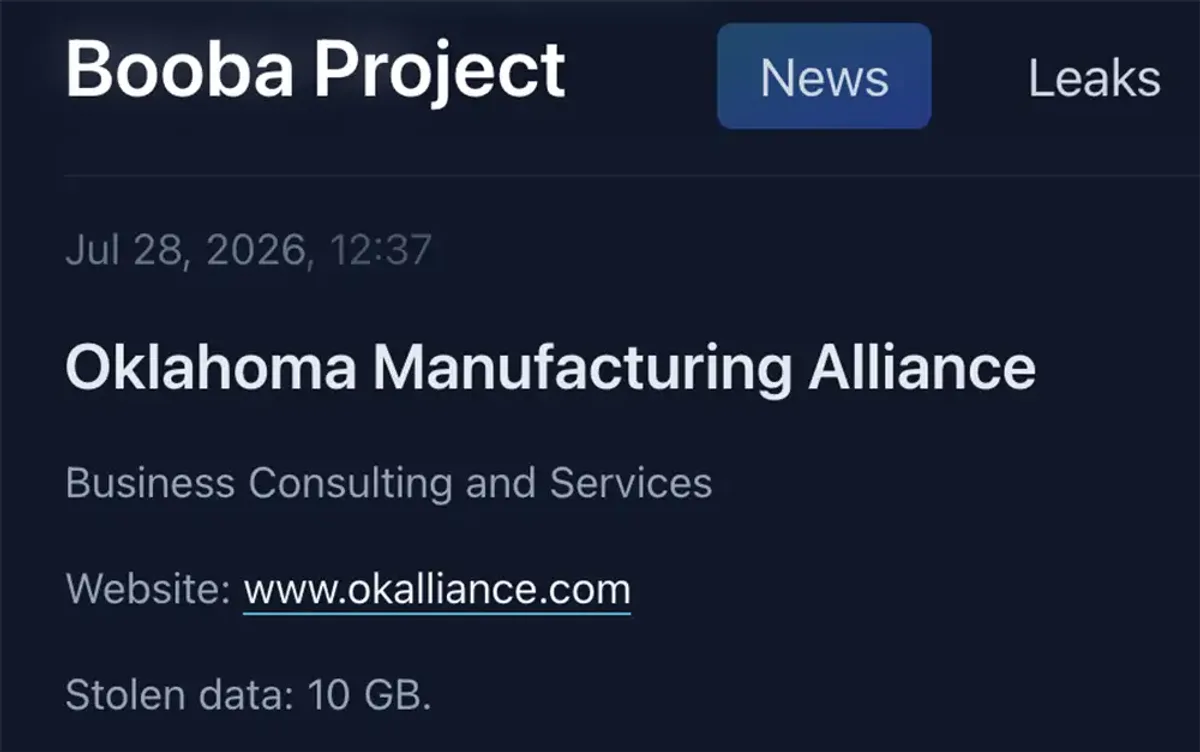
Booba Project publicly claimed it breached OMA, obtained 10 gigabytes of data and would release the material if a ransom was not paid, according to News 9. DysruptionHub treats those statements as unverified threat-actor claims. OMA said it found no evidence that information was removed and that client records were maintained on a separate system not involved in the incident.
Current status
The operational disruption is resolved because OMA restored access through a separate secure network on July 15. The organization continued working with IT professionals to review the event and strengthen security measures, but no later source identified renewed disruption.
Confidence and uncertainty
Confidence is high that ransomware affected two employee computers and a limited network segment because OMA directly confirmed those facts. Confidence is also high that access was restored the same morning.
Confidence in Booba Project attribution is low. A cybersecurity consultant documented the group’s public claim, but the available evidence does not independently establish that the claimant operated the ransomware found on OMA’s computers or verify the alleged 10-gigabyte theft. Data theft remains unconfirmed: the group alleged exfiltration and threatened publication, while OMA said its review found no evidence of removal and no compromise of separately stored client records.
Analytic gaps
The public record does not establish the initial access vector, phishing involvement, compromised account, exploited vulnerability, malware family, encryption scope, affected files, lateral movement, persistence, forensic indicators, ransom amount, direct victim contact, payment status, proof of the claimed 10-gigabyte dataset, publication status or law-enforcement involvement. It also does not identify which internal functions lost access or whether any non-client administrative information was viewed or copied.