Analyst assessment
DysruptionHub assesses with high confidence that the City of Milton, Florida, experienced malicious cyber activity beginning December 26, 2025. The city later said it detected suspicious activity consistent with ransomware and immediately secured its network, according to WEAR. That direct acknowledgment supports a high ransomware assessment, but the public record does not confirm encryption, a ransom demand, payment, decryption activity or a specific ransomware family.
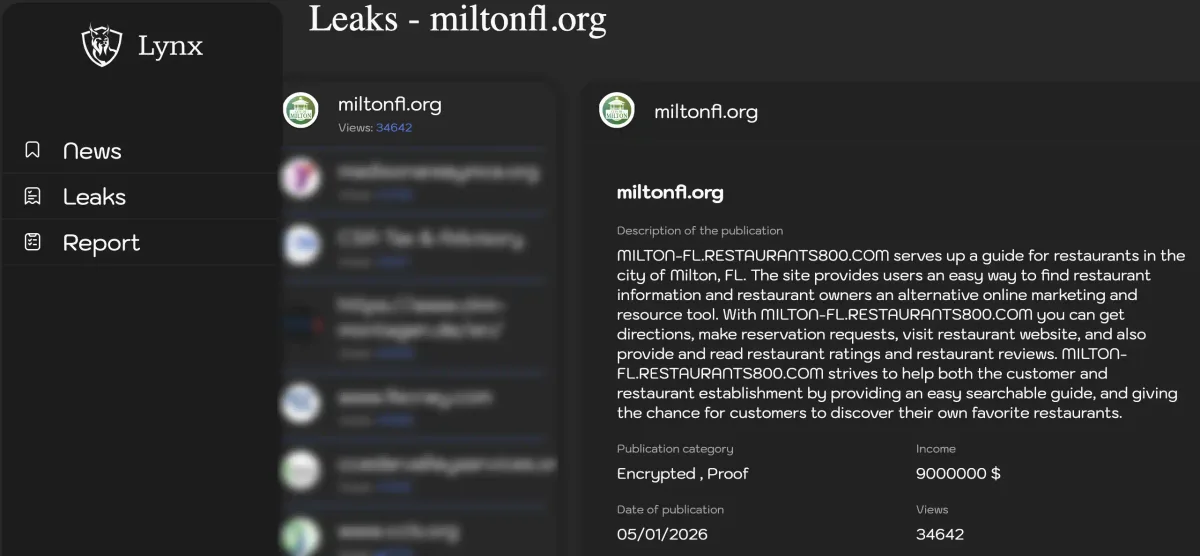
The earliest located public cyber signal was a January 5 Lynx leak-site listing naming miltonfl.org, the city’s official domain. The city did not publicly characterize the December activity as suspected ransomware until June. The listing predates that disclosure but does not itself verify Lynx attribution.
Operational significance
The incident materially disrupted municipal utility billing and payment operations. Milton’s January 16 notice said January bills had not been issued because of network repairs and that some customers had not received December bills. Customers were told to pay the amount of their most recent bill, while January late fees and shutoffs were suspended.
On February 6, the city said the network outage affecting billing had been resolved and statements would resume. Its restoration notice said December and January balances would be combined, automatic payments had been paused and some online accounts temporarily displayed a zero balance. The city continued fee and shutoff accommodations while balances were corrected.
The consequences extended beyond initial system restoration. Milton’s February 25 update said some customers were receiving bills covering multiple cycles and offered in-person payment plans without late fees or disconnection. DysruptionHub’s published report says online utility payments returned March 31 and the city declared utility billing fully restored May 1.
Disclosure posture
Milton’s early notices described network repairs, a network outage and a system outage without identifying cyber activity. The city publicly described the event as activity consistent with ransomware in June, about six months after detection. It said City Council and appropriate authorities had been notified and that state and federal law enforcement, cybersecurity specialists and legal counsel assisted the investigation.
The city reported no indication that city information was accessed, acquired, copied, leaked, posted publicly or otherwise taken. That supports no known confidentiality breach, but it does not erase the documented availability impact: billing data and accurate account balances were temporarily unavailable to authorized staff and customers.
Current status
Milton reported utility billing operations fully restored on May 1, 2026, and said shutoffs would resume for outstanding balances. This positive restoration statement supports resolved status and a May 1 operational end. Searches through July 26 found no renewed billing or payment disruption tied to the incident.
Confidence and uncertainty
Confidence is high that malicious cyber activity caused the disruption because Milton directly described activity consistent with ransomware and documented the contemporaneous network-related billing outage. Ransomware confidence remains high rather than confirmed because the public record does not establish encryption or an extortion demand.
Attribution to Lynx remains low confidence. The listing names the official city domain and closely follows the December 26 detection date, but its embedded description refers to an unrelated restaurant directory. Milton did not confirm Lynx, and DysruptionHub found no attached sample files or public tranche of city data.
Analytic gaps
The public record does not identify the initial access vector, compromised account or host, affected systems, malware family, encryption scope, ransom-demand or payment status, restoration method, or why the cyber characterization was not disclosed until June. It also does not establish whether the Lynx listing reflected actual access, mistaken targeting or an unsupported claim.