Analyst assessment
DysruptionHub assesses that Southeastern Oklahoma State University experienced a confirmed cyber incident affecting its technology environment beginning July 30, 2026. The university’s public notices described a network or service disruption, while KXII reported that university officials characterized the event as an attack by cybercriminals and a cybersecurity incident.
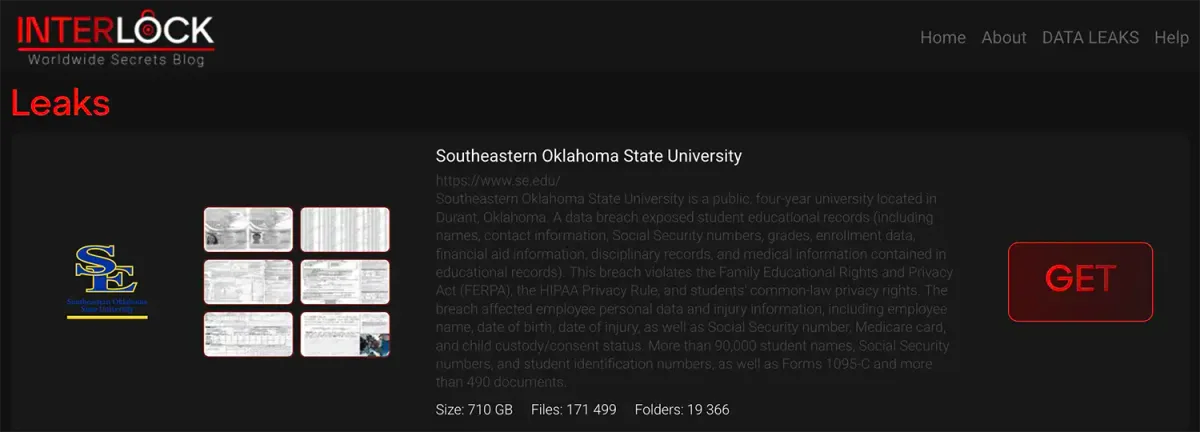
An Interlock claim recorded by ransomware.live names Southeastern Oklahoma State University and se.edu. Screenshots of Interlock’s Worldwide Secrets Blog show the group alleging a 710 GB collection containing 171,499 files and 19,366 folders. Interlock claims the material includes student names, contact details, Social Security numbers, grades, enrollment and financial-aid data, disciplinary and medical information, Forms 1095-C and more than 490 documents. It also claims the collection includes records tied to more than 90,000 students and employee names, birth dates, injury information, Social Security numbers, Medicare cards and child-custody or consent information.
The leak page shows document thumbnails and a “GET” button. A separate screenshot shows a directory listing with 11 folders and their stated sizes, including Data, DataBase, forensic, Shares and Users. The images document what Interlock claimed to possess and presented as available through its site. They do not establish that the files are authentic, originated from the university or were downloadable in full. The university has not confirmed data theft, ransomware or Interlock’s involvement.
Operational significance
The disruption caused three days of closures at the Durant campus. Our report documented the July 30 and 31 closures, and the university’s August 2 update extended the closure through August 3 while system restoration continued.
Canvas and certain online student systems remained available during the disruption, indicating that the closure did not eliminate every educational service. The public record does not identify specific effects on email, identity services, payments, research systems, housing, public safety or satellite locations.
Disclosure posture
The university directly acknowledged the disruption, restoration work, campus closures and continuity of some student-facing services but did not use cyber terminology in the reviewed first-party notices. KXII attributed the cyber characterization to university officials. DysruptionHub treats that as organization-confirmed cyber evidence reported through an independent outlet while preserving the wording difference.
The Interlock claim has no established publication date, so it does not alter the existing organization-first disclosure sequence. The claim adds an external attribution and data-publication allegation but does not establish ransomware or resolve the university’s more cautious public wording.
Current status
The material disruption is presumed resolved. By August 18, the university’s homepage showed fall classes, Welcome Week and ordinary campus events underway, and current student and employee service links were available. No newer source documented continuing campus closure or material service disruption after August 3.
The university has not published an incident-specific technical all-clear or final investigative conclusion. The status reflects the resumption of ordinary operations rather than a finding that every technical recovery task is complete. The later Interlock disclosure claim does not, by itself, indicate continuing service-delivery impact.
Confidence and uncertainty
Confidence is high that a material systems disruption forced three days of campus closures because the university documented those effects directly. Confidence is medium in the public characterization of malicious cyber activity because the victim wording is available through KXII’s attributed reporting, while the stable Interlock claim provides separate but uncorroborated external cyber evidence.
Confidence is medium that Interlock published the listing and displayed alleged samples and a directory interface because direct screenshots show those elements. Ransomware confidence and Interlock attribution confidence remain low. The screenshots do not establish encryption, a ransom demand, exfiltration, authentic data publication or actor responsibility. Data impact remains unknown because no reviewed source independently verifies whether university information was accessed, copied, altered, encrypted, deleted or exposed.
Analytic gaps
The public record does not identify the initial access vector, exploited vulnerability, compromised account or host, malware family, affected-system inventory, dwell time, encryption scope, verified exfiltration scope, ransom demand or payment, third-party role beyond reported incident-response support, restoration method or technical recovery date. It also does not establish when Interlock published its claim, whether the displayed files are authentic or complete, whether the advertised collection was downloadable, or whether the stated volume and record counts are accurate.