Analyst assessment
DysruptionHub assesses with high confidence that Kittson County experienced a cyber incident that triggered a precautionary state access block and disrupted local driver’s-license and motor-vehicle services. The county’s June 11 DMV closure update said it had reported a cyber incident involving its emergency-services network to Minnesota IT Services. MNIT then blocked the county’s access to state motor-vehicle systems as a precaution.
The public record does not establish that the county’s DMV network was compromised. County officials said the emergency-services network was separate from the DMV network and remained operational. The documented DMV disruption therefore resulted from a defensive access-control decision by the state following the reported cyber incident, rather than from a confirmed compromise of the DMV environment itself.
Operational significance
Kittson County first told residents on June 4 that its driver’s-license and motor-vehicle office was temporarily closed until further notice and advised people to call before visiting. The June 11 memo said full DMV services were unavailable because MNIT had blocked access to state systems. The disruption affected license services, vehicle registrations, title transfers and other state-connected transactions.
The office remained open for limited functions. It could accept payments for vehicle tabs to be mailed later and continue Department of Natural Resources license transactions. Those workarounds reduced the impact but did not restore normal service, and the county said there was no estimated timeline for full DMV access.
Disclosure posture
The county directly acknowledged a cyber incident involving its emergency-services network on June 11 and explained the resulting state access block. It did not identify the affected systems, incident start date, initial access vector, malware family, data impact, law-enforcement involvement or whether 911, dispatch or sheriff’s-office systems were targeted. The disclosure confirmed a cyber event and operational consequence but not its technical scope.
Current status
The last direct evidence of operational impact is the county’s June 11 memo. Searches through July 26 found no newer report showing that the DMV restrictions continued and no authoritative notice confirming restoration. With 45 days since the last observation, the incident is presumed resolved rather than active, but the final access-restoration date and investigative outcome remain unknown. The county’s current DMV page lists normal transaction types and office hours while still advising residents to call ahead for availability; because that page is undated, it does not establish a restoration date.
Confidence and uncertainty
Confidence is high that a cyber incident was reported and that Minnesota’s precautionary access block caused a material service disruption because the county described both facts publicly. Data availability was affected because authorized county staff could not access state motor-vehicle systems and records needed for normal transactions. Whether any county or state data was accessed, copied, altered or encrypted remains unknown.
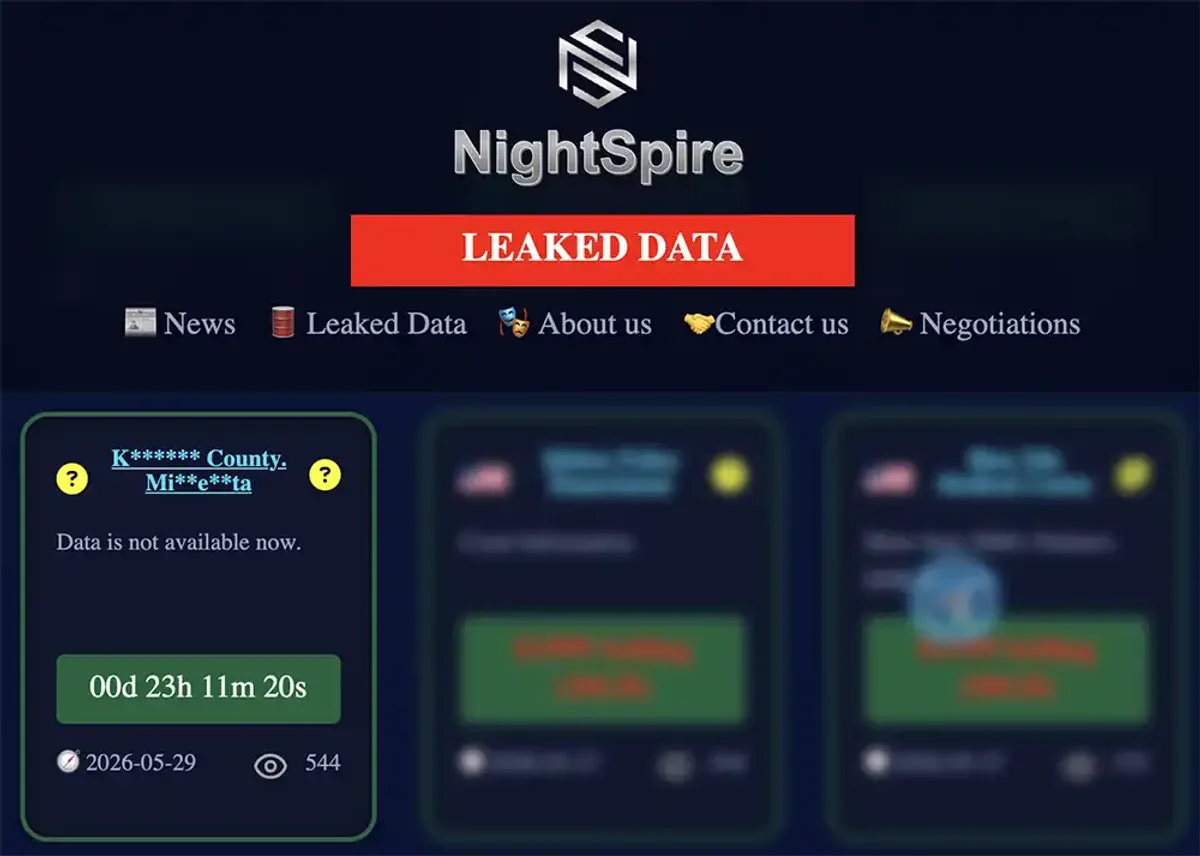
Confidence is low that NightSpire was responsible. DysruptionHub’s published report described an obfuscated May 29 NightSpire listing that appeared consistent with Kittson County and included a countdown timer, but the county did not confirm the group, ransomware, data theft or a ransom demand. The listing remains an actor claim, not confirmed attribution, and does not establish that data was copied, encrypted or published.
Analytic gaps
The public record does not identify when the cyber incident began, how access was obtained, which emergency-services systems were involved, whether any county network was compromised, whether data was accessed or removed, or whether the county received an extortion demand. It also does not establish when full DMV services resumed, whether additional county functions were affected or whether MNIT completed a final security review.