Analyst assessment
Los Angeles Metro detected unauthorized activity March 16 and restricted employee access to internal administrative systems. The Los Angeles Times reported April 2 that restoration remained underway and that Metro was reviewing about 1,400 servers individually before returning them to service. Bus and rail service and safety systems continued operating, but the incident affected arrival information, service alerts and some TAP fare-loading channels.
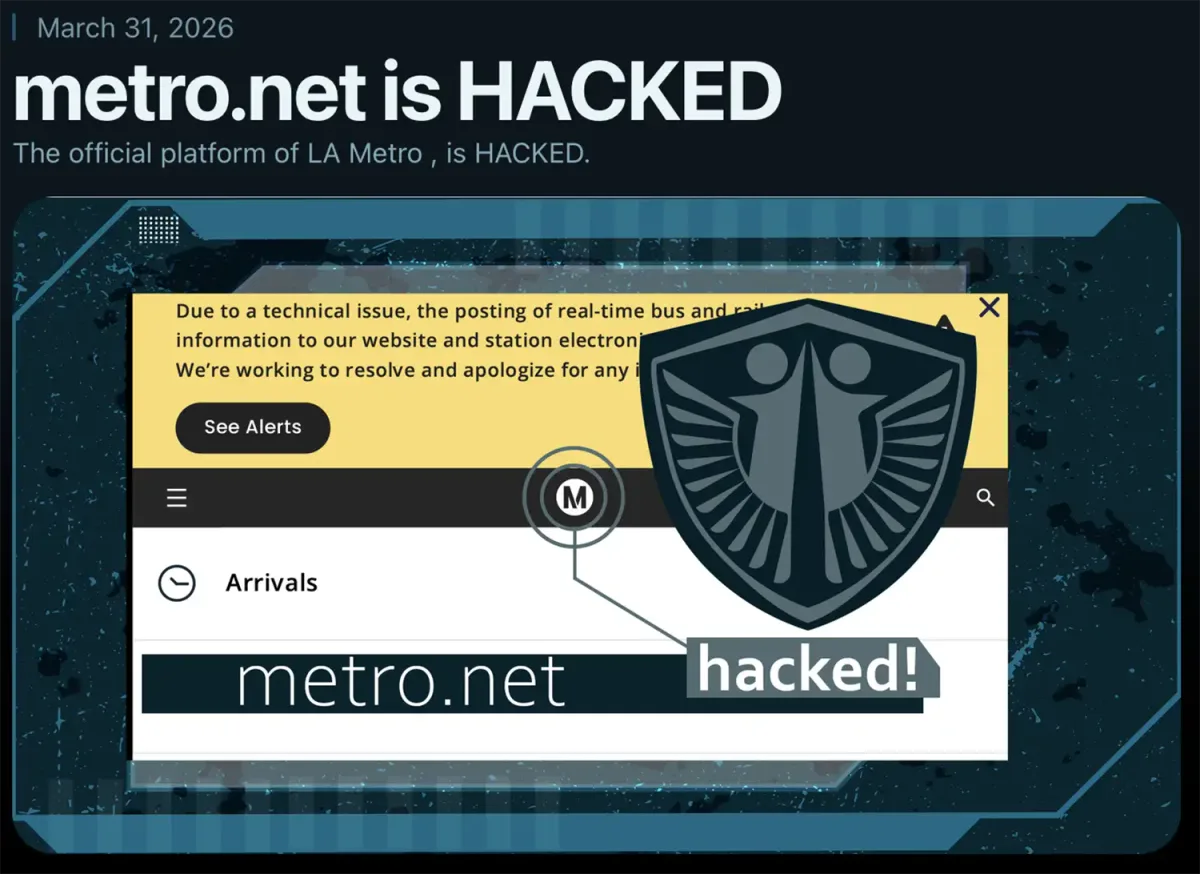
Ababil of Minab claimed the intrusion March 31. The actor alleged that it wiped more than 500 terabytes and stole more than 1 terabyte of sensitive data, offered a 17.1-megabyte proof-of-concept archive and threatened more severe future action. Those figures and the full destruction claim remain unverified.
Later technical research materially strengthened the underlying claim. Gambit Security found custom exfiltration tooling and infrastructure overlap with an Iran-linked operation, while Hunt.io found more than 1 gigabyte of LA Metro database backups, operational and personnel records, SCADA configurations, yard-management material and employee email archives on an exposed staging server associated with the campaign. DysruptionHub therefore assesses with high confidence that data was stolen and that Ababil of Minab was connected to the intrusion.
Operational significance
The incident disrupted administrative and customer-information systems across LA Metro’s Los Angeles County service area. Arrival monitors stopped displaying real-time information, service alerts were delayed and riders encountered problems reloading TAP cards through some channels. Metro maintained essential bus and rail circulation and said transit safety and security systems continued operating.
The prolonged server-by-server recovery establishes material operational disruption even though the agency’s core transportation service continued. Public evidence does not establish that train-control or other operational-technology systems were manipulated. Images posted by the actor purported to show access to a rail-yard management display, but that assertion was not confirmed by Metro.
Disclosure posture
LA Metro’s public cyber wording preceded the actor claim. Metro acknowledged unauthorized activity and system restrictions in reporting published before Ababil of Minab’s March 31 website post, supporting an organization-first cyber-transparency assessment.
The actor’s post is a stable victim claim, not proof of every assertion. Gambit and Hunt.io independently linked LA Metro data and operator tooling to the broader operation, but Metro told Reuters that attribution remained under investigation and that it would not speculate. No U.S. government agency publicly attributed the incident in the reviewed sources.
Current status
The incident is presumed resolved. The latest authoritative source documenting continuing impact was the April 2 Los Angeles Times report that system restoration remained underway. No later authoritative source identified continuing service-delivery effects or a formal all-clear.
Confidence and uncertainty
Confidence is high that a cyber intrusion caused the administrative restrictions and rider-facing degradation because LA Metro directly acknowledged unauthorized activity. Confidence is also high that data was stolen because researchers found LA Metro material on infrastructure associated with the operation.
Threat-actor confidence is high, but not confirmed. The direct claim, matching victim data and campaign infrastructure support Ababil of Minab attribution; Metro did not confirm the actor, and Hunt.io did not independently verify Gambit’s further attribution to Iran’s Ministry of Intelligence and Security.
The evidence supports destructive activity but not ransomware. No reviewed source identified encryption, a ransom demand, payment instructions or a payment condition. The actor published a sample and threatened future harm, but its public messaging was ideological rather than financial.
Analytic gaps
The public record does not establish the initial-access vector, compromised account, exploited vulnerability, dwell time, full affected-system inventory, verified destruction volume, complete stolen-data volume, affected-person count, notification obligations, final restoration date or whether operational technology was directly altered. It also does not establish whether any organization besides Ababil of Minab participated in the intrusion or whether the Iranian government directed the operation.