

Colebrook officials said a hacked town email account led the State of New Hampshire to suspend some town connections, disrupting access to vital records, elections, DMV services and dispatch-related systems.
In a March 27 notice, the town said its connectivity with state systems tied to the Town Clerk’s Office and dispatch had been temporarily suspended after the email compromise. Officials said the state disconnected the town to prevent the issue from spreading through other state-connected systems. Littleton Reporter, a North Country local news outlet, was among the first to report the disruption.
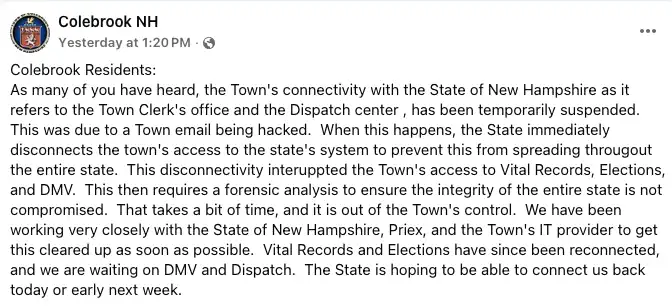
The interruption cut off access to vital records, elections and DMV functions, according to the town. Colebrook said it was working with the state, Primex and the town’s IT provider while a forensic analysis was underway.
Town officials have not said who was responsible or specified the exact nature of the activity, and no public claims of responsibility have surfaced. DysruptionHub did not receive a response to an emailed request for comment.
The outage was publicly visible at least a week earlier. A March 19 notice on the town website said the computer programs used for motor vehicle registrations and vital records were down, indicating residents were already dealing with service problems before officials publicly tied the issue to a hacked email account.
By March 27, officials said vital records and election functions had been reconnected, while DMV and dispatch access were still pending. The town said the state hoped to restore those remaining connections that day or early the following week.
Officials have described the event as a hacked email account and a cybersecurity incident, but they have not publicly said whether malware, ransomware or data theft were involved. There is also no public confirmation that any resident, election or dispatch data was accessed.

Chip in once
If this reporting helped you, a one-time tip helps cover hosting, tools and future investigations.

Support us monthly
A small monthly pledge keeps independent coverage and our reader tools online for everyone.
Colebrook is a Coös County town of about 2,100 residents. Its clerk’s office handled about 3,300 motor vehicle registrations in 2022, underscoring how quickly even a limited disruption to state-connected systems can affect routine services.
Colebrook’s outage is not the first cyber disruption to hit Coös County. In 2025, Coös County Family Health Services disclosed a cyberattack that disrupted systems and raised concerns about possible data exposure, underscoring how even smaller public-serving institutions in the North Country face growing operational cyber risk.
Elsewhere in New Hampshire, cyber incidents have also disrupted county offices, courts and school systems. Hillsborough County said a 2025 incident forced some county systems offline, Strafford County courts saw proceedings disrupted after an attack on electronic communications systems, and school districts in Pelham and Hudson reported incidents that affected core operations.
Email compromise remains a common entry point into public systems. New Hampshire’s 2026 Cyber Threat Assessment says attackers use phishing emails to steal credentials and access government email systems, and the FBI reported 21,442 business email compromise complaints with more than $2.7 billion in adjusted losses in 2024.
Colebrook’s response also resembles a 2025 incident in Russell Township, Ohio, where county officials cut off police email for weeks after suspicious network activity raised concerns that a compromise could spread through connected justice-system infrastructure. In both cases, officials treated the risk to broader government-connected systems as reason enough to isolate access first and sort out the technical details later.
Officials have not publicly said whether any data was accessed or whether the compromise extended beyond one email account. They also have not issued a final timetable for restoring all affected services.


