

Fessenden-Bowdon School in Fessenden, North Dakota, says a cybersecurity incident affecting its Google domain is disrupting staff email and may trigger phishing messages from school accounts, prompting warnings to families.
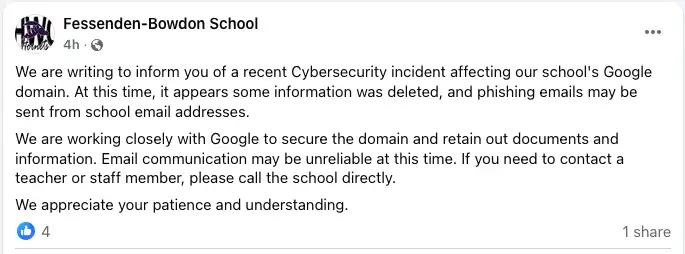
The district first posted Monday morning that it was experiencing an email outage. In an update later in the day, it told families it is responding to “a recent cybersecurity incident” affecting the school’s Google domain, saying some information appears to have been deleted and that phishing emails may be sent from school email addresses. Email may be unreliable, and families who need to reach teachers or staff have been urged to call the school directly.
Officials did not label the attack type, but the description of compromised school accounts that could be used to send fraudulent messages is consistent with what federal agencies describe as business email compromise, or BEC, in which criminals hijack or spoof legitimate email accounts to trick victims into sending money or sensitive data.
Administrators said they are working with Google “to secure the domain and retain our documents and information,” but did not say what triggered the incident, whether any accounts were taken over long term or whether law enforcement or outside forensics firms are involved. They have not provided a restoration timeline or said whether backup systems are being used to recover deleted documents.

Chip in once
If this reporting helped you, a one-time tip helps cover hosting, tools and future investigations.

Support us monthly
A small monthly pledge keeps independent coverage and our reader tools online for everyone.
Fessenden-Bowdon is a small rural K-12 district in Wells County, serving fewer than 200 students on a single campus in central North Dakota. The district relies heavily on Google services, including Chromebooks and online tools, according to its technology materials.
North Dakota has seen fewer headline cyber incidents than many larger states, but local agencies have been hit. In December, Fargo Park District reported a cybersecurity event discovered in October that disrupted phone, email and internal systems; ransomware group Interlock has claimed responsibility, and third-party forensic specialists are still investigating.
Education networks nationwide are frequent targets for phishing and BEC schemes that mimic school communications and attempt to steal passwords, financial data or tax information. The FBI and Federal Trade Commission advise recipients of suspicious messages not to click links, to confirm requests through a known phone number and to report phishing attempts to providers and regulators.
The district has not said whether North Dakota’s data breach notification law will apply. That could depend on whether investigators ultimately find that personal information about students, staff or families was accessed or copied, not just deleted or used for spam.


