Skip to content

Elsevier web-portal hijack

Summary

Elsevier logo

Elsevier’s Sept. 21 web redirects disrupted coursework and manuscript access before normal service returned. Elsevier attributed the event to a compromised credential and reported bounded forensic findings. Operational disruption is presumed resolved; an undated Moffitt access-block notice does not establish a current restriction.

Key facts

Timeline

  • Incident start:
    ? Earliest known or assessed start of malicious activity or incident activity.
  • First public signal:
    ? Earliest public indication of an outage, disruption, closure or other observable incident impact. The signal does not need to mention cybersecurity.
  • First public cyber evidence:
    ? Earliest credible public information connecting the incident or disruption to malicious cyber activity.
  • Official cyber disclosure:
    ? First official acknowledgment by the affected organization or an authoritative public body that the incident was cyber-related.
  • Last impact seen:
    ? Latest public indication that disruption, degraded operations, recovery work or unresolved impact was still ongoing.

Primary victim organization

Critical infrastructure sector

Incident characteristics

Assessments

Attack mechanisms

Data impacts

  • Unknown data impact

    The incident is cyber-related, but available evidence does not establish whether or how data was affected.

Operational impacts

  • Online portal unavailable

    A public, customer, employee, student, patient, vendor, or partner portal was unavailable or materially impaired.

  • Educational operations disrupted

    Instruction, student services, school administration, learning platforms, transportation, or other educational operations were materially affected.

  • Downstream organization impact

    The incident caused operational effects at customers, affiliates, subsidiaries, partners, tenants, or other dependent organizations.

Extortion indicators

  • No known extortion indicator

    Available evidence indicates that no extortion demand, threat, communication, or related pressure tactic was identified.

Incident narrative

Analyst assessment

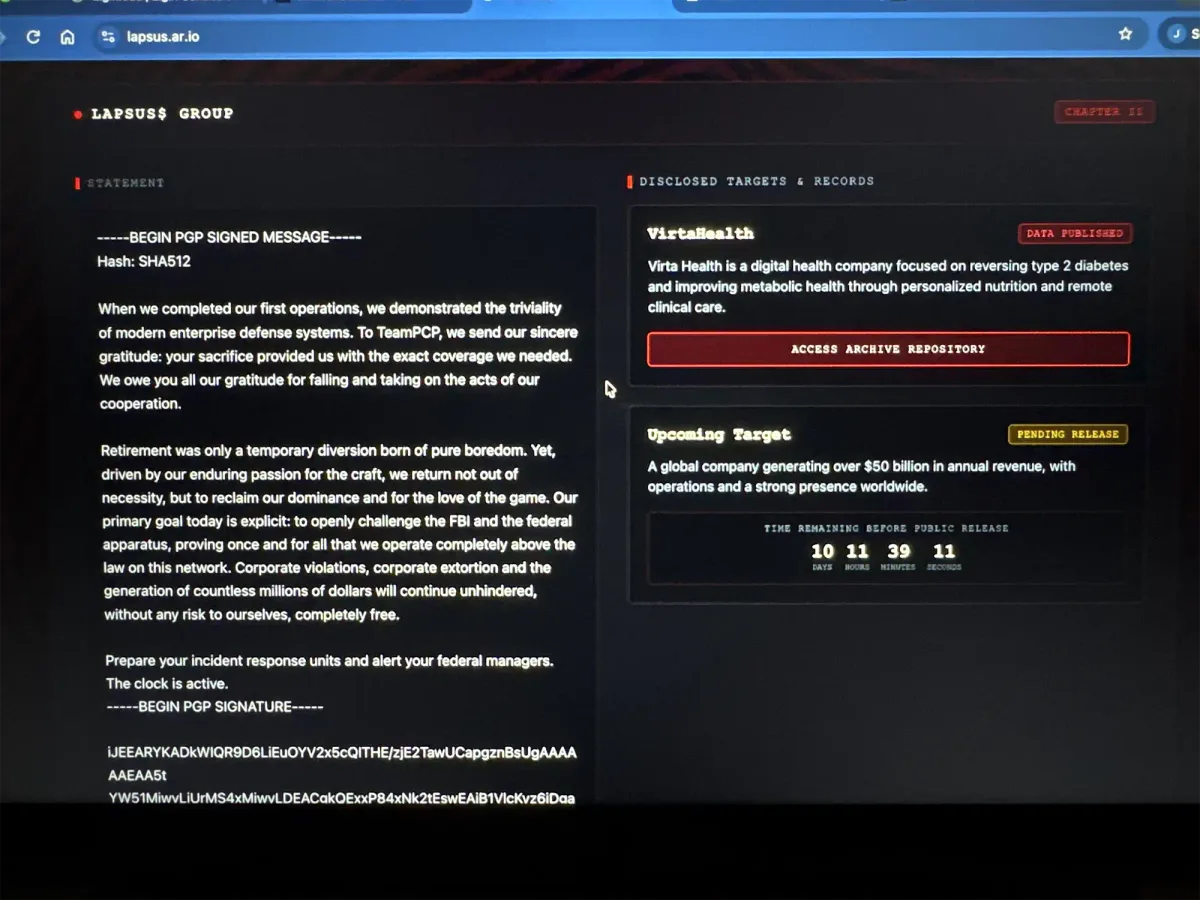
DysruptionHub assesses with high confidence that Elsevier experienced malicious web-traffic redirection on Sept. 21, 2026. Cloudskope’s live checks found that Elsevier.com, Evolve.elsevier.com and Submit.elsevier.com sent visitors to a page branded “LAPSUS$ GROUP, Chapter II.” In a statement to DataBreaches.net, Elsevier confirmed that visitors to selected platforms were redirected to a third-party page and said its cybersecurity team restored normal service. The redirection is established. Elsevier later said a compromised credential initiated the incident; the operator and how the credential was obtained remain unestablished.

Operational significance

The redirect interrupted access to Elsevier’s company site, education portal and manuscript-submission portal for at least 78 minutes. KTVO reported that Truman State University nursing students were sent to the branded page while trying to use Elsevier for homework. That documents downstream educational disruption, not a breach of Truman’s systems. Grand Canyon University’s tech-support team reported an outage affecting Evolve and other Elsevier resources. Western Governors University nursing students reported that they could not reach Elsevier-linked quizzes and course materials. The GCU notice is institutional; the WGU evidence is student reporting, and neither establishes a breach of the schools’ systems. Sorami Consulting reported that a Gold Standard Drug Database authentication endpoint also redirected token requests, but its public account did not provide request logs or identify a patient-care interruption.

In a filing with the Idaho attorney general, Boise State University said it disabled single sign-on to Interfolio (Faculty 180) as a precaution and re-enabled it at 8:30 a.m. Sept. 22. The university said Interfolio was not affected and no university-hosted service or data was shown compromised. Boise’s restriction continued after the Elsevier web redirects had stopped.

Current status

Cloudskope found the observed redirects cleared Sept. 21, and Elsevier said it restored normal service. Boise State restored its precautionary sign-on restriction the following morning. Elsevier’s trust-center statement describes the event as contained and effectively addressed.

Moffitt Cancer Center’s library retains an undated notice describing a precautionary block on Elsevier resources. The notice still says Elsevier has not issued a public statement, a premise superseded by Elsevier’s published findings. Its continued display does not establish that the block remains enforced. It does not establish a Moffitt breach or patient-care interruption.

Operational disruption is assessed as presumed resolved as of Nov. 2. Current downstream access restrictions and the date every precautionary block ended remain unconfirmed.

Confidence and uncertainty

Confidence is high that the redirects occurred and disrupted access, based on live checks, a university support notice, affected-user reporting and Elsevier’s acknowledgement. The 78-minute duration is a verified minimum, not a precise start-to-finish measure. Sorami’s additional API-endpoint observation remains a single-source report, and it does not establish a clinical-service outage or compromise of core systems. Elsevier said its investigation found no indication that core platforms, customer data, research content or operational systems were compromised; that is not a final public technical report ruling out every possible exposure.

Elsevier’s trust-center statement, updated Oct. 16, said the compromised credential or key had been deprecated and replaced. It said an external forensic firm reviewed extensive logs and system artifacts supplied by Elsevier and found unauthorized activity limited to approximately 15 minutes Sept. 21, with no evidence of access to infrastructure or product platforms, data exfiltration or activity outside that window. Those are attributed findings within the firm’s review. The approximately 15-minute activity window differs from Cloudskope’s minimum 78-minute observation of redirects; the public accounts do not explain that timing difference. Neither duration establishes the complete user-impact period, including downstream precautionary blocks.

The redirect creates a low-confidence association with the “LAPSUS$ Chapter II” persona because Elsevier traffic reached its branded page. It is not an Elsevier-specific actor claim: the page named another victim and an unidentified future target, not Elsevier. Securonix found that the page was staged before the Elsevier redirect and could not tie its operator to the original LAPSUS$ group. The public evidence does not establish who controlled the redirect, ransomware, an Elsevier ransom demand or data theft. The Maryland Heights, Missouri, location is an Elsevier-listed U.S. office, not a documented site of office-specific disruption.

Analytic gaps

Elsevier identified a compromised credential or key but has not publicly explained how it was obtained, which routing control it enabled or who used it. The public record does not reconcile the forensic activity window with the longer observed redirect duration, or identify when every downstream precautionary restriction ended. The number of affected users and the full scope of any additional redirected endpoints remain unverified.


Threat actor and claim

Source: otherDiscovered:

Claim details

Elsevier web traffic was redirected Sept. 21, 2026, to a page branded “LAPSUS$ GROUP, Chapter II”. The page did not name Elsevier as a victim or claim access to its systems, possession of its data or a ransom demand.

Securonix found that the page predated the redirect. The operators behind the page and the party that changed Elsevier’s routing remain unidentified. The branded destination provides a low-confidence association with Chapter II, but does not establish a claim of responsibility or attribution.

Screenshot documenting LAPSUS$ Chapter II claim

Organizations involved

Impacted locations

  • Phoenix, Arizona

    Phoenix is the university’s main-campus anchor; vendor resource outage does not establish campus network compromise.

  • Tampa, Florida

    Tampa anchors Moffitt Cancer Center and its documented precautionary reference-resource restrictions; no citywide outage or patient-care interruption inferred.

  • Boise, Idaho

    Boise State’s primary place anchors its documented precautionary single sign-on restriction; no university-hosted service or campus network compromise was reported.

  • Kirksville, Missouri

    Medium Confidence

    Physical anchor for Truman nursing students’ documented downstream access disruption; no claim that the campus network was compromised.

  • Maryland Heights, Missouri

    Medium Confidence

    Physical anchor for Elsevier’s listed U.S. corporate office in Maryland Heights; web-portal redirection was not shown to affect this office or its network specifically.

  • Salt Lake City, Utah

    Medium Confidence

    Salt Lake City is the online university’s headquarters anchor, not the physical location of affected students or a demonstrated headquarters outage.

Sources

Elsevier web hijack disrupts Missouri nursing coursework

Our reporting brought together Elsevier’s redirect and restoration, Truman State student disruption, GCU’s Evolve outage notice, WGU nursing-student accounts and Boise State’s precautionary sign-on restriction.

LAPSUS$ Chapter II: Signed, Staged, but Still Unattributed

Securonix traced the Chapter II page to an Arweave object published Sept. 2 and verified its signed statement, but found no bridge to the original LAPSUS$ operators. The preexisting page did not name Elsevier.

Elsevier.com, Evolve and Manuscript Submission Redirected to LAPSUS$ for at Least 78 Minutes

Cloudskope reported direct checks showing www.elsevier.com, evolve.elsevier.com and submit.elsevier.com returned HTTP redirects to a LAPSUS$-branded page. It observed the redirect still live at 9:07 p.m. Central and cleared by 10:09 p.m. Sept. 21.

Boise State University cybersecurity reporting on Elsevier redirects

Boise State reported disabling single sign-on to Interfolio (Faculty 180) as a precaution during Elsevier website redirects. It reenabled SSO Sept. 22 and said Interfolio, university-hosted services and data were not shown compromised.

Brief hijack makes Elsevier domains redirect to LAPSUS$ ‘Chapter II’ page

Help Net Security reported that Elsevier’s main website, Evolve education portal and manuscript-submission portal redirected users to a LAPSUS$-branded page for at least 78 minutes on Sept. 21 and were subsequently accessible and functional again.

Elsevier Evolve, ClinicalPharmacology, and GSDD APIs Hijacked: LAPSUS$ Redirect Campaign

DataBreaches.net reproduced an Elsevier statement confirming Sept. 21 redirects to a third-party page, a cybersecurity-team response and restored service. Elsevier said its investigation found no indication that core platforms, customer data, research content or operational systems were compromised.

Elsevier Evolve, ClinicalPharmacology, and GSDD APIs Hijacked: LAPSUS$ Redirect Campaign Hits Healthcare Infrastructure

Sorami Consulting said production authentication endpoints, including api.gsdd.net/auth/AccessToken, redirected token requests to a LAPSUS$-branded page. It did not publish raw request/response artifacts or document a patient-care interruption.

TSU nursing program faces temporary hijacking of homework website

KTVO, citing Truman Media Network’s Index, reported that Truman State nursing students trying to use Elsevier for homework were redirected to a hacker-branded message, and that the site returned to normal after about three hours.

GCU Tech Support: Evolve/Elsevier resources outage

GCU Tech Support told students that an outage affected Evolve/Elsevier resources and that it was working toward resolution; it identified global ticket 4065335.

WGU/Elsevier Hacked

A self-described WGU nursing student reported an error while working on a course; commenters said Elsevier links for quizzes showed the LAPSUS$-branded page. These are student accounts, not an institutional WGU notice.

What the heck is LAPSUS$ GROUP?

A user’s image shows lapsus.ar.io displaying a LAPSUS$ GROUP Chapter II statement, disclosed-target panel and countdown after reaching the page while trying to access Elsevier.

Academic publisher Elsevier hit by LAPSUS$ redirect attack

Elsevier directly confirms temporary traffic redirection, restored service and no indication of core-platform/customer-data compromise; additional scope and duration questions unanswered.

Elsevier Website Issue Update — Oct. 16 forensic findings

Elsevier attributes Sept.21 redirects to a compromised credential/key replaced after the event. Its external forensic firm reviewed supplied logs/artifacts, reporting an approximately15-minute activity window and no evidence of infrastructure/product access or exfiltration; timing differs from earlier redirect observations.

About Kirksville

The City of Kirksville identifies Kirksville as the Adair County seat in northeast Missouri.

Contact the Nursing Department

Truman State University lists its Department of Nursing at 100 E. Normal Ave., Kirksville, Missouri 63501, establishing the location of the affected student program.

Elsevier office locations

Elsevier identifies itself as a global business headquartered in Amsterdam and lists offices in several U.S. states. The page is an identity and geography source, not a statement about the Sept. 21 redirect.

Maryland Heights comprehensive plan

The city comprehensive plan describes Maryland Heights as a city in St. Louis County, Missouri.

GCU main campus in Phoenix, Arizona

GCU identifies its main campus at 3300 W. Camelback Road in Phoenix and describes campus, online and evening programs, including nursing.

Western Governors University institutional catalog, March 2026

The catalog describes WGU as an online university without a physical student campus and lists its headquarters at 4001 S. 700 East, Suite 700, Salt Lake City, Utah.

About Moffitt

Institutional profile identifies cancer care, research and education functions.

Moffitt Locations

Official facility directory anchors Moffitt’s Tampa headquarters and cancer center.

Temporary Access Disruption: Elsevier Resources

Observed Oct.22: the library’s current notice still says Moffitt Information Security blocks Elsevier domains pending further information, affecting research and clinical-reference resources, with alternative access assistance offered.

See something that needs correction?

Signed-in members can report an error, update, or missing source.