Analyst assessment
fairlife temporarily suspended U.S. production after identifying unauthorized third-party access to part of its systems, including production-related infrastructure. Coca-Cola’s Form 8-K and fairlife’s initial notice connected the access to a ransomware event and said the company activated incident-response and business-continuity procedures, engaged outside specialists and notified law enforcement.
Coca-Cola’s July 27 update confirmed that the intruder took certain data. The company said most production had resumed across four U.S. facilities while restoration continued. DysruptionHub assesses with high confidence that the incident involved ransomware, material production disruption and data theft.
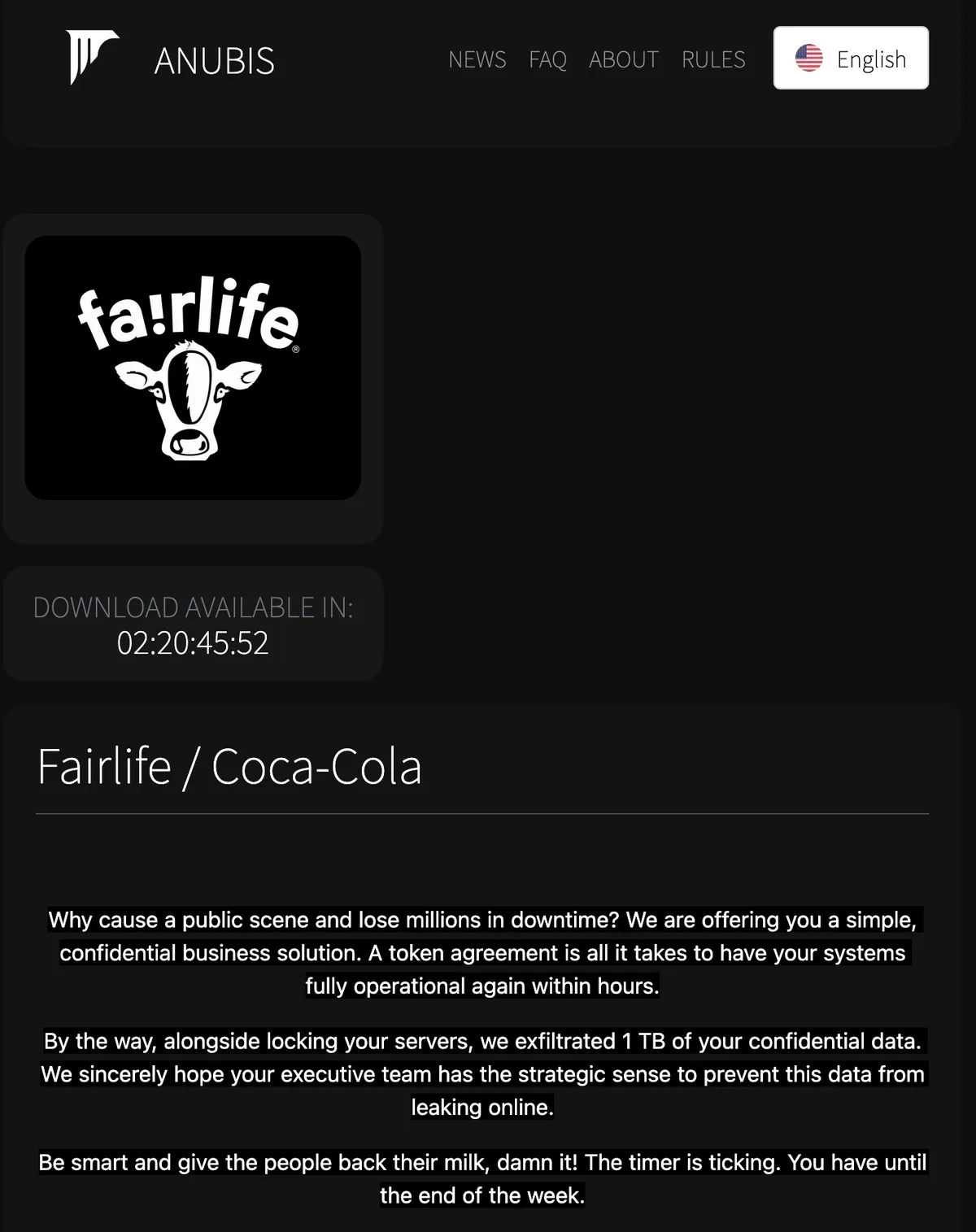
Anubis claimed responsibility, alleging that it encrypted fairlife’s Nutanix infrastructure, stole about 1 TB of corporate data and would publish the material unless negotiations began by a July 27 deadline. The Atlanta Business Chronicle later reported that the group claimed to have released engineering, production and human-resources material. Coca-Cola has not corroborated the actor, claimed encryption scope, data volume or publication.
Operational significance
The incident interrupted fairlife’s U.S. manufacturing footprint for ultra-filtered milk and protein beverages. Canadian production and product quality and safety were unaffected. Coca-Cola said existing inventory largely protected retail availability and that the event was not expected to materially affect its financial condition or results.
The resumption of most production substantially reduced the disruption but was not a complete all-clear. The company continued restoring impacted systems and operations and did not identify which production capabilities remained limited.
Disclosure posture
Coca-Cola directly established ransomware, unauthorized access, data theft, the production suspension and partial operational recovery through an SEC filing and fairlife-hosted statements. The disclosures do not identify an actor, ransom demand, affected data categories, record count, notification population or final recovery date.
The Anubis publication claim and related civil allegations increase the significance of unresolved data-exposure questions but do not authenticate the alleged files or establish that they came from the confirmed theft.
Current status
The incident is presumed resolved. Coca-Cola’s July 27 statement remains the latest authoritative operational update and said most production had resumed while restoration of impacted systems and operations continued. No later source documented continuing production or service-delivery impact by Aug. 26, 30 days after the last confirmed impact observation. The status does not establish a precise full-restoration date or the conclusion of the investigation.
Confidence and uncertainty
Cyber, ransomware and operational-impact confidence are high because Coca-Cola directly confirmed the ransomware connection, unauthorized access, production suspension and partial recovery. Data theft is also confirmed, but its categories and scale remain unresolved.
Threat-actor confidence remains low. Anubis made a specific claim consistent with the confirmed event and later claimed to release data, but Coca-Cola did not corroborate the actor and the reviewed reporting did not independently authenticate the alleged files, Nutanix encryption or one-terabyte volume.
Analytic gaps
The public record does not establish when malicious activity began, the initial-access vector, exploited vulnerability, compromised account, dwell time, malware build, affected hosts, backup impact or whether operational technology was directly compromised. It also does not establish the verified contents of the stolen or allegedly published data, the number of affected people or records, notification obligations, ransom amount, payment decision, fourth impacted facility represented in the official count, full restoration date or final investigative findings.