

University City, Missouri, officials now say a cyberattack caused a monthlong outage that disrupted online services including bill payments, building permits and public document requests.
The confirmation follows weeks in which the city publicly described the disruption as a “network outage” related to “server issues.” In a July 23 response to DysruptionHub, Communications Manager Jared Jones said the disruption was caused by “a cyberattack carried out with malicious intent” that disrupted network connections and prevented access to several essential city systems and online services.
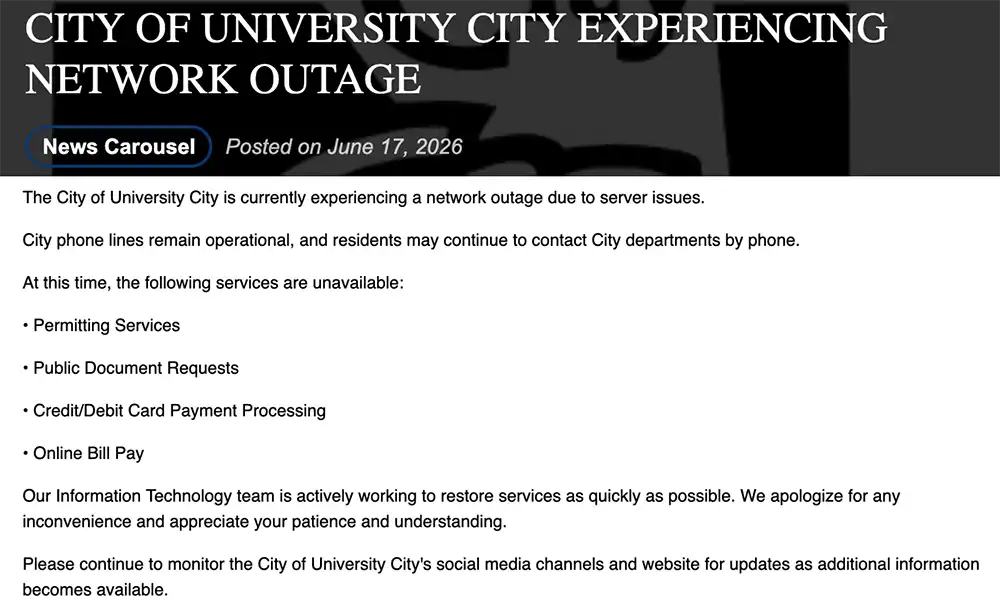
The city first posted a public notice June 17 saying it was experiencing a “network outage due to server issues.” It said city phone lines remained operational, but permitting services, public document requests, credit and debit card payment processing and online bill pay were unavailable.
Jones said July 23 that University City became aware of the network disruption June 19. It was not immediately clear why that date came two days after the city’s first public outage notice.
“Upon identifying the malicious activity, the City immediately began working with its technology partners and cybersecurity professionals to investigate the incident, stop the attack, and restore access to affected systems,” Jones said.
The disruption blocked access to routine city services used by residents, contractors and businesses. University City is a St. Louis County municipality of about 34,700 residents, according to the U.S. Census Bureau.
A June 22 update posted to the city’s social media accounts said the outage was continuing and remained related to “ongoing server issues.” The city said there had been “no significant change” in the outage status and that affected services remained unavailable.
City staff and technical support personnel were continuing to diagnose and resolve the issue, but the city said at the time it did not have an estimated restoration time.
DysruptionHub asked the city June 22 and June 23 whether the outage involved unauthorized access, malware, ransomware or precautionary system shutdowns. Jones said June 23 that University City was “not in a position to comment on the specific cause of the outage or speculate regarding potential contributing factors while the matter remains under review.”
The city is not providing additional details about the specific nature of the attack. Jones did not say whether ransomware was detected.
Based on the investigation to date, Jones said, the city has found no evidence that personal information was accessed or removed.
“The malicious activity was stopped before personal information could be taken,” Jones said. “The investigation and recovery efforts remain ongoing, and the City will provide additional information if the findings change.”

Chip in once
If this reporting helped you, a one-time tip helps cover hosting, tools and future investigations.

Support us monthly
A small monthly pledge keeps independent coverage and our reader tools online for everyone.
Some city systems and online services have been restored, but recovery work remains ongoing, Jones said. The city is rebuilding and restoring affected systems in phases “to maintain system integrity and security,” he said.
“At this time, the City does not have a confirmed date for full restoration,” Jones said.
The city did not identify the affected systems, name the technology partners or cybersecurity professionals involved in the response, say whether law enforcement or state officials were notified, or say which services remain unavailable.
The city’s website remained online during the outage, suggesting the disruption affected business systems or connected service platforms rather than the city’s main public website. The city’s homepage continued to display the outage notice and link to public-facing services.
The city said its investigation and recovery remain ongoing, with no confirmed date for full restoration.


