

A cybersecurity incident affected automated controls supporting Maple Plain’s water utility Monday, but the Minnesota city said its drinking water remained safe and water and wastewater services continued without interruption.
City employees used contingency procedures to maintain normal operations after identifying the incident early Monday, according to a city news release. Maple Plain did not identify the affected controls or say whether they had been restored.
The affected technology supported water infrastructure. Maple Plain is a small city in western Hennepin County, about 20 miles west of Minneapolis.
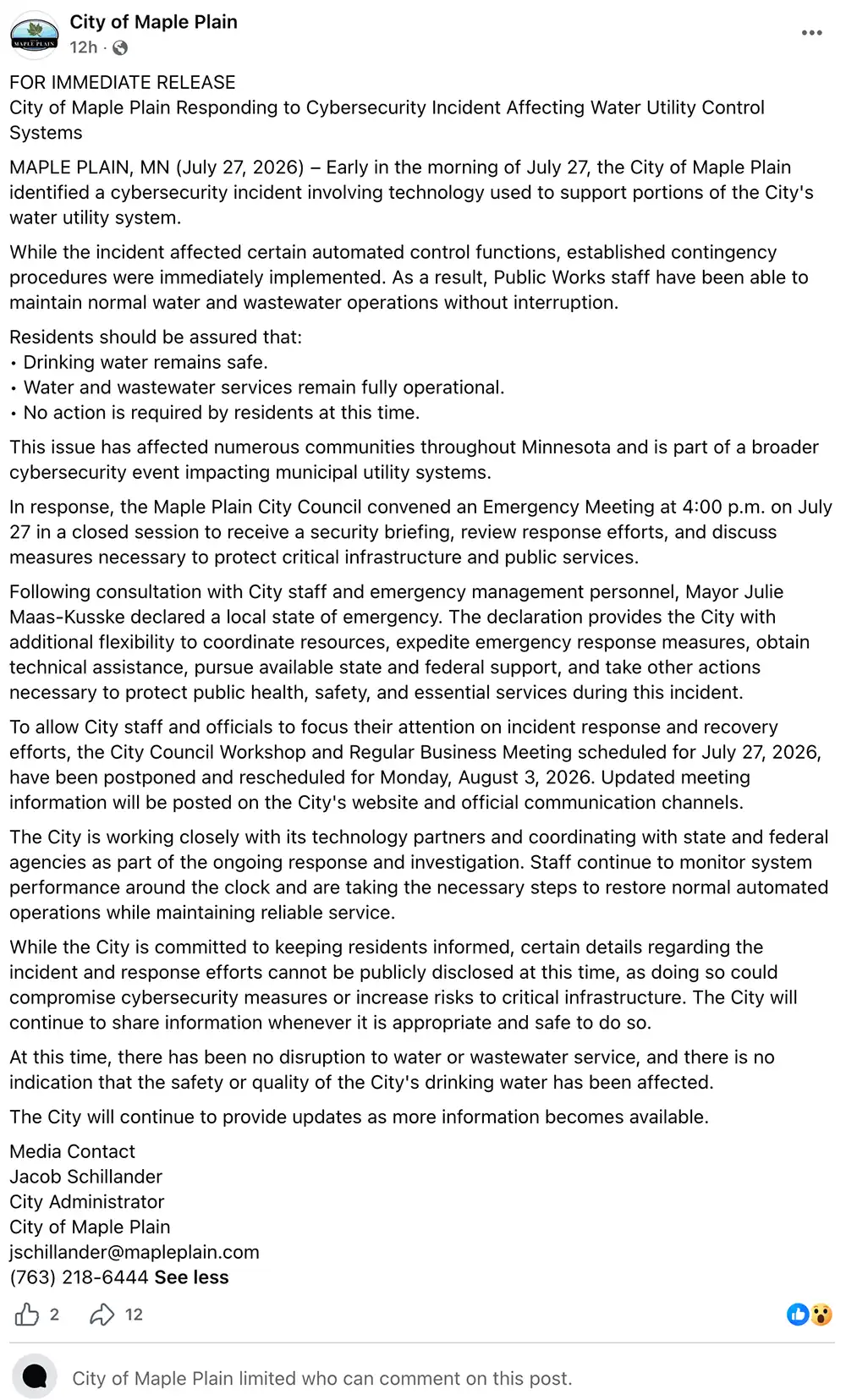
The City Council held an emergency meeting Monday afternoon to review the response and measures to protect critical infrastructure and public services. Officials said residents did not need to take action.
Maple Plain was the fourth Minnesota municipality to publicly report a July 27 cyber incident involving water or wastewater technology.
In Braham, a cyberattack disabled computerized operating controls and temporarily shut down the city’s well and water treatment plant. Public works crews restored the plant within about two hours, and officials said the drinking water remained safe.
Plymouth reported a suspected cyberattack that disrupted cellular communications with two water towers and several wastewater lift stations. Crews used manual procedures, and officials said water levels, water quality and service were unaffected.
South St. Paul said a cybersecurity incident affected some automated water utility controls, but employees maintained normal water and wastewater operations through contingency procedures. The city also said its drinking water remained safe.

Chip in once
If this reporting helped you, a one-time tip helps cover hosting, tools and future investigations.

Support us monthly
A small monthly pledge keeps independent coverage and our reader tools online for everyone.
Braham officials said they had been told that at least four other communities were attacked “with the same result.” Maple Plain’s disclosure means at least one municipality referenced by Braham has not been publicly identified.
The cities used different descriptions for the incidents. Braham confirmed a cyberattack, Plymouth said it suspected one, and Maple Plain and South St. Paul described cybersecurity incidents without identifying an attack method.
Federal agencies had recently warned that Iranian-affiliated cyber actors were targeting internet-facing programmable logic controllers used across U.S. critical infrastructure, including water systems. The advisory said the activity could disrupt operations by manipulating industrial controls and display data.
Officials have not linked the Minnesota incidents to that campaign. They also had not disclosed how Maple Plain’s systems were accessed, which equipment or software was affected, or whether data was accessed or stolen.
No ransom demand or threat actor had been identified, and officials had not confirmed whether the four incidents shared an attacker, technology provider or vulnerability.


