

A cyberattack disrupted Tidewater Telecom internet service across dozens of communities in coastal Maine beginning Sunday, limiting municipal operations before service returned to near-normal conditions Tuesday.
The outage affected residential, business and government connections across a broad coastal service area. Tidewater and affiliated provider Lincolnville Communications Inc. are part of a family-owned Maine telecommunications company that maintains thousands of miles of telephone and fiber-optic lines.
Tidewater and LCI determined that an external, computer-generated attack had targeted their internet systems, the companies told News Center Maine. They said they had found no indication that customer data was compromised.
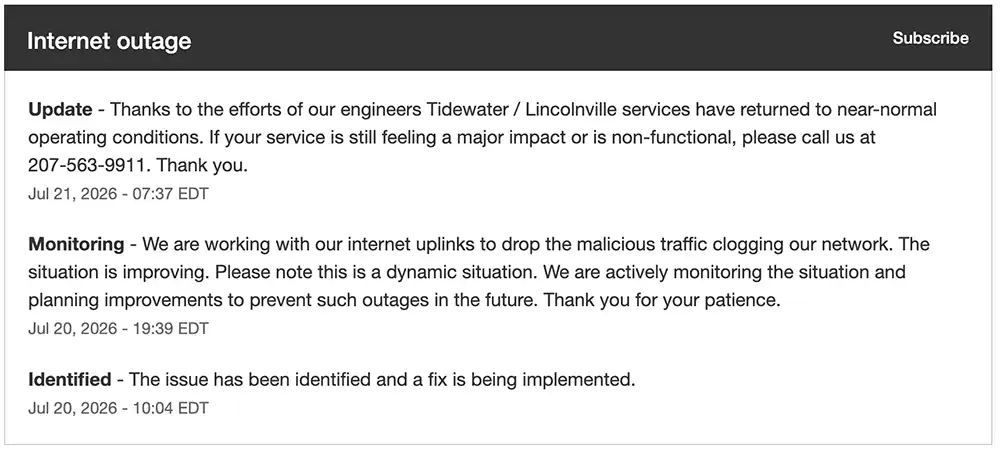
The companies later described the attack as malicious traffic that was clogging their network. Engineers worked with upstream internet providers to block the traffic, according to Tidewater’s official status page.
The outage also disrupted local government services. The Damariscotta Town Office said it had spotty or no internet access, significantly limiting staff because most office functions depend on an internet connection.
Officials advised residents to call before visiting to confirm that employees could provide the service they needed.

Tidewater initially said Monday morning that it had identified the problem and was implementing a fix. By Monday evening, the provider said conditions were improving but cautioned that the attack remained dynamic.
At 7:37 a.m. Tuesday, Tidewater said its and Lincolnville’s services had returned to near-normal operating conditions. It asked customers whose connections remained unusable or severely affected to contact the company. The status page listed customer internet service as operational, although traditional voice service was still classified as experiencing a major outage.
The provider’s status page listed internet service locations from Bangor and Bath to Belfast, Camden, Damariscotta, Rockland and Waldoboro, along with smaller coastal towns and villages. Tidewater offers residential and business internet, telephone and streaming television services from its headquarters in Nobleboro.
The Maine disruption followed a separate denial-of-service attack last week against Greenfield Communications in California. That outage cut internet service for nearly 48 hours in Rancho Murieta and other parts of Sacramento County, disrupting payments and local services.
Tidewater had not publicly identified the specific attack type. Its description was consistent with a traffic-flooding attack, but the company had not confirmed that it was a distributed denial-of-service attack.
Spectrum customers also reported service problems in parts of coastal Maine during the Tidewater disruption, but no public evidence established that the outages were connected. The providers operate separate local networks, although they could depend on common regional fiber routes, transit carriers or interconnection facilities farther upstream.

Chip in once
If this reporting helped you, a one-time tip helps cover hosting, tools and future investigations.

Support us monthly
A small monthly pledge keeps independent coverage and our reader tools online for everyone.
Tidewater had not publicly identified the specific attack method. The company’s description of malicious traffic clogging its network was consistent with a traffic-flooding attack, but it had not confirmed a distributed denial-of-service attack.
DysruptionHub contacted Tidewater for additional information but did not receive a response by publication.


